
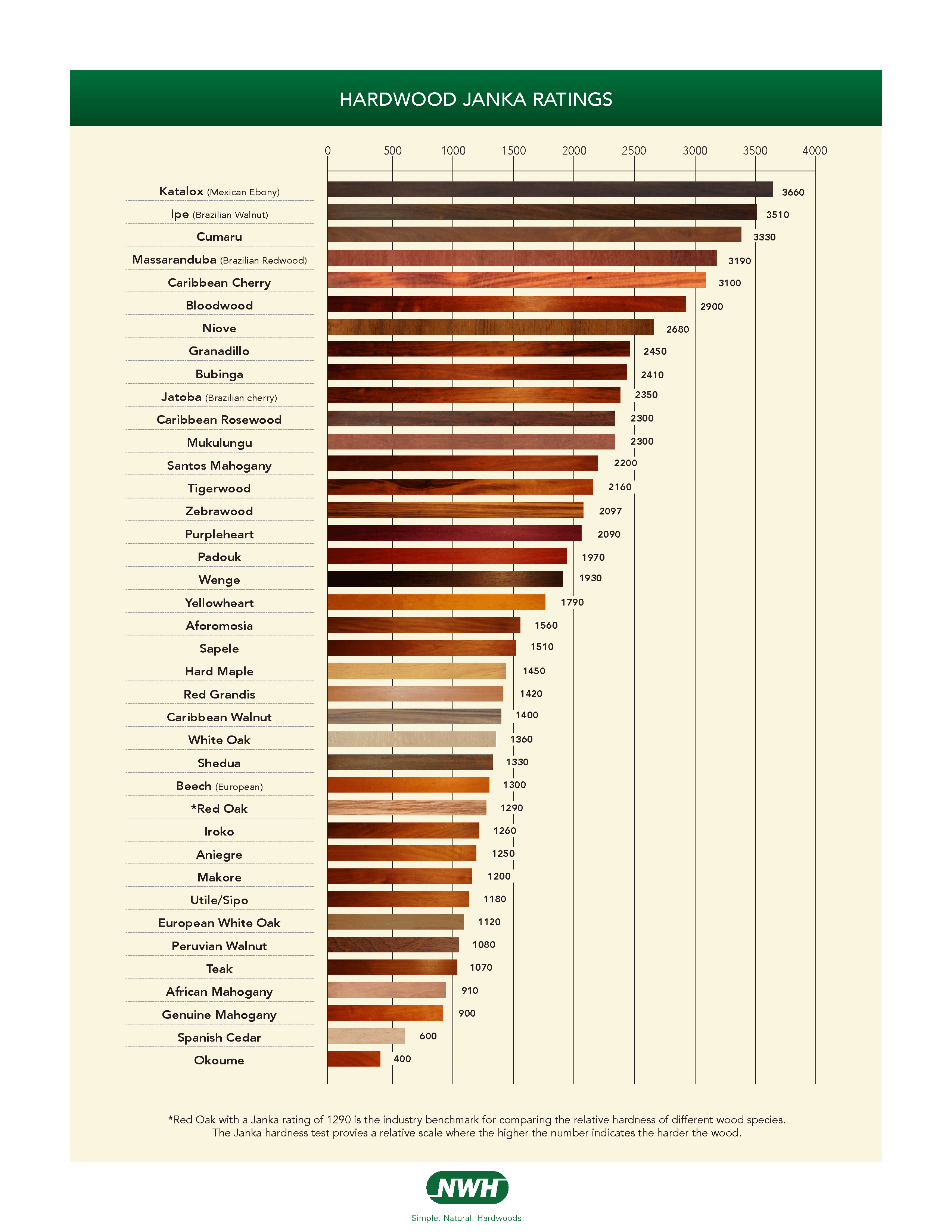
Janka Rating refers to a standardized measurement of the hardness of wood species, determined by the force required to embed a 0.444-inch steel ball halfway into a wood sample. The Janka Hardness Test, developed by Austrian researcher Gabriel Janka and standardized by ASTM D1037, quantifies a wood’s resistance to denting and wear. It is widely used in flooring, furniture, cabinetry, and millwork industries to compare durability among hardwood and softwood species. Higher Janka ratings indicate harder, more dent-resistant wood, though other factors like grain structure, finish, and dimensional stability also affect real-world performance.
Janka Rating
|
|
|---|---|
| Category | Material Testing, Wood Science |
| Subfield | Hardness Measurement, Flooring Performance, Structural Materials |
| Key Characteristics | Numerical scale, dent resistance, species-specific values |
| Primary Applications | Flooring durability, material selection, wear performance |
| Industry Impact | Material specification, consumer guidance, quality benchmarking |
| Sources: ASTM Wood Standards, NWFA Guidelines, Wood Database Resources | |
Other Names
Janka Hardness, Janka Scale, Janka Test, Wood Hardness Rating
History
1900s: Origins of the Janka Test
The Janka test was developed by Gabriel Janka, an Austrian-born researcher, to provide a quantifiable method for evaluating wood hardness. It was later adopted and standardized by the U.S. Forest Products Laboratory and codified as ASTM D1037.
Mid-20th Century: Standardization and Industry Use
The Janka scale became the industry benchmark for specifying flooring and cabinetry materials, especially as engineered and exotic hardwoods entered the market. It helped architects and contractors assess suitability for high-traffic or commercial areas.
2000s–Present: Consumer Awareness and Product Labeling
The Janka rating is now commonly listed in product specifications and marketing for hardwood flooring. As consumers became more educated about performance characteristics, the Janka scale became a key decision-making metric.
Technical Specifications
Test Methodology
The Janka Hardness Test involves embedding a 0.444-inch steel ball into the surface of a wood sample to half its diameter (0.222 inches). The force required is measured in pounds-force (lbf) or newtons (N), depending on regional standards. ASTM D1037 defines sample preparation, moisture content (usually 12%), grain orientation (side or end), and testing procedure.
Scale and Interpretation
- Low Janka (< 1000 lbf): Softwoods like Eastern White Pine (380 lbf)
- Medium (1000–2000 lbf): Domestic hardwoods like Red Oak (1290 lbf)
- High (> 2000 lbf): Exotic species like Brazilian Walnut (3680 lbf)
Note that vertical grain and engineered construction can affect field performance independent of raw Janka values.
Applications
Hardwood Flooring Specification
Janka ratings are crucial in flooring selection, especially in high-traffic or commercial settings. Species with higher ratings resist dents from furniture, pet claws, and foot traffic. Installation type and finish type also influence performance.
Furniture and Millwork
Janka data informs cabinetry and millwork material choices, where dent resistance is important for longevity. In furniture making, balance between hardness and workability is considered.
Best Practices
Material Selection
Use Janka ratings in combination with dimensional stability, grain pattern, availability, and finish compatibility. Consider engineered options where dimensional stability is more critical than surface hardness.
Design Integration
Specify wood species appropriate to use-case: high-Janka species for commercial floors or kitchens; medium-hardness species for residential interiors; low-hardness species where aesthetic and acoustic goals outweigh durability.
Industry Standards
Testing and Certification
ASTM D1037 is the primary standard governing wood hardness testing in North America. Flooring manufacturers and third-party certifiers conduct independent testing under controlled conditions.
Product Labeling and Specification
Hardwood flooring products should list Janka values in technical specifications. NWFA recommends using Janka ratings as part of performance classification alongside dimensional stability and finish wear layer.
Key Considerations
Planning Phase
Balance desired hardness with budget, availability, and installation method. Harder woods may require pre-drilling and more robust tooling. Regional climate may impact performance of species with high hardness but low dimensional stability.
Implementation
Ensure accurate Janka data is referenced from standardized test results. Account for grain direction, moisture content, and substrate compatibility during installation.
Material Trade-offs
Very hard woods (Janka > 3000) may be brittle and difficult to machine, requiring carbide tools and specialized adhesives. Softwoods may dent easily but are easier to install and repair.
Maintenance Implications
While Janka rating reflects dent resistance, surface finish affects scratch resistance and long-term appearance. Use felt pads on furniture and avoid dragging objects to preserve floor condition.
Common Misunderstandings
Janka rating does not measure scratch resistance, moisture behavior, or finish durability. It is a mechanical test of compressive strength at a single point, not a complete measure of wear or structural integrity.
Project Impact
Performance Optimization
Selecting wood species with appropriate Janka hardness improves durability and reduces lifecycle maintenance. In hospitality and retail spaces, this reduces repair frequency and enhances visual longevity.
Client Communication
Providing clear, comparative Janka data helps clients make informed decisions based on use-case rather than aesthetics alone. Visual charts or side-by-side samples improve understanding.
Industry Impact
Product Development and Innovation
Manufacturers use Janka data to develop hybrid products, such as engineered hardwoods with high-Janka wear layers over stable cores. It also informs finish development to complement hardness levels.
Global Species Comparison
Janka ratings allow comparison between global wood species, supporting import/export decisions, substitution for endangered species, and regulatory compliance under programs like FSC or the Lacey Act.
Current Debates
Relevance vs. Real-World Performance
Some argue that over-reliance on Janka ratings ignores finish type, substrate, and installation variables that have greater impact on in-use durability. Professionals advocate for holistic material performance analysis.
Sustainability of High-Janka Exotics
Exotic hardwoods with high Janka ratings often come with environmental trade-offs. Designers increasingly seek alternatives that balance performance with sustainable sourcing and certification.
Related Technologies
Digital Specification Tools
Software platforms allow filtering of flooring products by Janka rating, dimensional stability, and LEED credits. BIM integration ensures consistent material specs across documentation sets.
Hardness Testing Equipment
Laboratory-grade Janka testers and automated ball-embedment rigs ensure consistent pressure application, digital readouts, and data logging for QC and certification purposes.
Research and Development
Composite Surfaces and Wear Resistance
R&D focuses on developing engineered surfaces with higher wear resistance than their Janka rating would suggest, such as ceramic-fused laminates and aluminum oxide topcoats.
Sustainable Wood Alternatives
Thermally modified woods, cross-laminated bamboo, and bio-based composites offer medium to high Janka ratings with improved environmental performance and carbon footprint reduction.
FAQs
What is a good Janka rating for flooring?
Most residential floors use species with a Janka rating of 1,000–2,000 lbf. Commercial spaces may require harder woods (> 2,000 lbf) for greater durability.
Is a higher Janka rating always better?
Not necessarily. Very hard woods may be brittle, expensive, or difficult to install. The right choice depends on application, climate, and user needs.
Does the Janka rating apply to engineered wood?
Engineered flooring uses Janka ratings of the wear layer species, not the core. Overall product durability includes substrate and finish considerations.
How is the Janka test conducted?
A steel ball is pressed into the wood until it reaches half its diameter. The force required is recorded and standardized. Grain orientation and moisture content affect results.
Can finish affect Janka results?
No. The Janka test is performed on bare wood. Finishes may influence scratch resistance but do not alter the Janka rating itself.
References
- ASTM International. (2023). ASTM D1037: Standard Test Methods for Evaluating Properties of Wood-Based Materials.
- National Wood Flooring Association (NWFA). (2023). Wood Species Technical Manual.
- U.S. Forest Products Laboratory. (2023). Wood Handbook – Wood as an Engineering Material.
- The Wood Database. (2023). Comparative Janka Hardness Chart by Species.